Art has an uncanny ability to stir up emotions and provoke thought-sometimes even pushing us right to the edge of what’s legally acceptable. As a lover of both free speech and creative expression, I find myself wondering: when does art cross the line? In this exploration, we’ll dive into the legal landscape that shapes artistic freedom, look at powerful examples of art as protest, and grapple with the controversies that arise when creativity clashes with societal norms. Let’s unpack the fine line between expression rights and censorship together!
Defining Free Speech and Artistic Expression
Free speech, which is often protected by the First Amendment, gives me the right to share my opinions without government interference, but there are some legal limits to keep in mind.
These limits cover things like hate speech, which can incite violence or discrimination, and obscenity, which many folks might find offensive based on community standards.
For example, the Supreme Court has this thing called the Miller Test to help determine what’s considered obscene. It looks at whether the average person, using current community standards, would see the work as appealing to prurient interests, lacking serious literary value, and being outright offensive.
Getting a grip on these boundaries is super important for me. It helps me navigate free speech in a responsible way, making sure I can express myself while also keeping the community’s safety and moral values in mind.
Understanding Artistic Expression
Artistic expression is my go-to way of tapping into creativity and exploring the cultural heritage. It’s all about challenging norms while reflecting what’s happening in society and sharing my own perspective, often through social commentary and cultural criticism.
Take Banksy, for example. His provocative imagery really gets people talking about social issues and raises awareness. When I see his work, like ‘Girl With a Balloon,’ I can’t help but feel the deep themes of hope and loss. It really makes me think about my own experiences.
Then there’s Ai Weiwei, whose installations, like ‘Sunflower Seeds,’ make me pause and consider cultural norms. He shines a light on the impact of mass production and invites us to think about the balance between individual and collective identity.
These examples show me that art isn’t just about expressing feelings; it’s also a powerful way to spark conversations in society and encourage us to think more deeply and engage with one another, thereby motivating artistic innovation.
The Legal Framework and Art Law
I find that understanding the legal framework around free speech and artistic expression is really important for navigating the complexities of creating art.
It helps me make sense of the challenges I might face in my work, including legal boundaries and ethical considerations.
Constitutional Protections and Judicial Precedent
The First Amendment gives me the freedom to express myself, practice my religion, gather with others, and petition the government. It really is the backbone of artistic protections here in the U.S.
Some landmark cases, like *Schenck v. United States* in 1919 and *Tinker v. Des Moines Independent Community School District* in 1969, really show just how far these freedoms can reach.
In *Schenck*, the Court decided that speech creating a “clear and present danger” could be restricted, which is an important point. On the flip side, *Tinker* stood up for student expression, making it clear that artistic endeavors-even in schools-deserve constitutional protection.
These rulings really highlight how crucial the First Amendment is for nurturing a vibrant artistic scene, allowing artists like me to express dissent and innovate without worrying about censorship, and setting important judicial precedent.
International Perspectives on Free Speech
I find it fascinating how different countries have their own take on free speech and artistic freedom. Some really prioritize artistic expression, while others have strict rules in place.
For example, in the United States, the First Amendment is like a big thumbs-up for free speech, which allows artists like Ai Weiwei to openly share their political views. But then you look at places like China and Iran, where artists can get into serious trouble for criticizing the government.
Take Jafar Panahi, the Iranian filmmaker, for instance. Back in 2015, he ended up in jail just for making films that the authorities found politically provocative. These examples really highlight the tricky balance between freedom of expression and government control, and they definitely shape the themes and messages that artists decide to put out there, impacting their artistic license.
Art as a Form of Protest and Art Activism
I’ve always believed that art is a powerful tool for protest. It allows me to challenge societal norms and advocate for change in a way that words alone sometimes can’t.
Historical Examples of Protest Art and Heritage Preservation
I find it fascinating how historical protest art, like Picasso’s ‘Guernica’ and the Vietnam War memorials, really highlights the power of visual storytelling in raising public awareness.
Take ‘Guernica,’ for example. It was created as a response to the bombing of a Spanish town during the Spanish Civil War, and it stands as a strong symbol against fascism.
Then there are contemporary works like the AIDS Memorial Quilt, which not only honors those lost to the epidemic but also advocates for public health awareness and LGBTQ+ rights.
These pieces go beyond just being art; they spark conversations and drive social change, reinforcing the role of art activism. By connecting art with important social issues, they resonate with people both emotionally and intellectually, often igniting movements that lead to legislative and cultural shifts.
Modern Movements and Their Impact on Social Justice
Contemporary movements like Black Lives Matter really inspire me as an artist to create impactful works that tackle systemic injustices through visual mediums.
Take Kerry James Marshall, for example, whose work is deeply rooted in social justice. He uses vibrant imagery to celebrate African American heritage and identity, shining a light on stories that often get overlooked in art history.
Then there’s Ai Weiwei, whose work, especially pieces like “Sunflower Seeds,” critiques government oppression and champions freedom of expression.
I find it fascinating how social media amplifies these important messages, letting artists reach wider audiences and spark meaningful conversations.
Hashtags like #ArtForChange transform individual expressions into collective movements, encouraging young activists to see art as a powerful form of political commentary. It’s exciting to be part of this dynamic landscape, where digital art and virtual galleries are becoming prominent!
Legal Cases Involving Artistic Expression and Art Law
Legal cases about artistic expression really highlight the constant struggle between creative freedom and societal standards.
It’s fascinating to see how these debates unfold and shape the way art is perceived and created, often impacting intellectual property rights.
Notable Supreme Court Cases and Their Legal Implications
Landmark Supreme Court cases like ‘Tinker v. Des Moines’ and ‘Miller v. California’ have really shaped how I think about artistic expression and the law.
In ‘Tinker v. Des Moines’ (1969), the Court backed up students’ rights to free speech, saying that schools need to show a legitimate reason to limit that expression. On the flip side, ‘Miller v. California’ (1973) set the bar for what counts as obscenity, laying out what qualifies as protected speech.
These rulings still resonate today, especially when we’re diving into debates about social media censorship, artistic installations, street art, and even graffiti.
I see artists referring to these cases all the time in their battles against censorship, standing firm on their First Amendment rights as they navigate the modern challenges of expression across different mediums, including online expression.
Lower Court Decisions and Their Implications for Art Policy
I’ve noticed that lower court decisions often reflect the community’s standards and values, which really impacts how we perceive and censor artistic expression.
Take, for example, a notable case from 2013 where a gallery decided to pull an artwork that was considered offensive. That sparked quite a debate about censorship and free expression.
Then there was a 2020 ruling regarding a mural featuring political figures that made everyone question the differences between public and private spaces in art. These kinds of decisions shape the legal landscape for artists and also get people talking about what’s acceptable in art.
It’s a tricky balance between artistic freedom and what society deems appropriate, often leading to self-censorship.
Controversial Art and Public Response in Art Institutions
I find that controversial art often sparks some pretty heated debates about censorship and what’s considered acceptable expression in our society.
It really gets people talking!
Censorship and Its Challenges in Art and Politics
Censorship in the arts really creates some tough challenges for all of us. It raises questions about moral standards and community values, and honestly, it can stifle creativity in a big way.
Take the 1989 exhibition “The Perfect Moment,” for example. That showcased the work of artist David Wojnarowicz, but his pieces were removed because they tackled provocative themes around sexuality and AIDS.
Then there’s “Piss Christ” by Andres Serrano, which has also faced a lot of scrutiny. It’s sparked debates about artistic freedom versus community outrage.
These cases show the broader implications for artists like me; we might end up self-censoring or changing our work just to dodge the backlash. In doing so, we limit our creative potential and the rich discussions that art can inspire.
The Role of Public Opinion in Art Criticism
Public opinion really shapes how controversial art is received, and I’ve seen how it affects the way artists deal with societal expectations, often influencing audience reception and interpretation. Take Andres Serrano, for example-his piece “Piss Christ” caused a huge uproar, but it also sparked important conversations about censorship and artistic freedom.
Then there’s Banksy, a known provocateur, who loves to push the envelope and challenge social norms. He uses public art to call out political issues, and his work gets people talking, even if it makes them uncomfortable. It’s fascinating to see how changing public attitudes can either validate or condemn an artist’s message, influencing the cultural discourse.
I’ve noticed that artists today can tap into social media for real-time feedback, enhancing audience engagement. This helps them steer their work to either align with societal views or challenge them, ultimately shaping the public discourse around what they create.
Future of Free Speech in Art
The future of free speech in art really depends on how societal standards evolve and how willing artists are to push back against the status quo with provocative art. With technology advancing at lightning speed, I can use platforms like social media to connect directly with a wider audience and skip over those traditional gatekeepers.
This democratization opens the door for all sorts of bold themes, from mental health to political dissent to climate change, and it feels like we’re seeing a significant shift in cultural conversations and art movements.
Take movements like #MeToo and Black Lives Matter, for example, which have become integral to expressive culture. They’ve had a huge impact on contemporary art, encouraging creators to dive into tough subjects without holding back. Simultaneously, the rise of AI technologies has sparked some interesting debates about authorship, originality, and artistic intent.
As an artist, I find myself navigating these new ethical waters while still making sure my voice is heard loud and clear, maintaining artistic integrity.
Encouraging Dialogue and Understanding
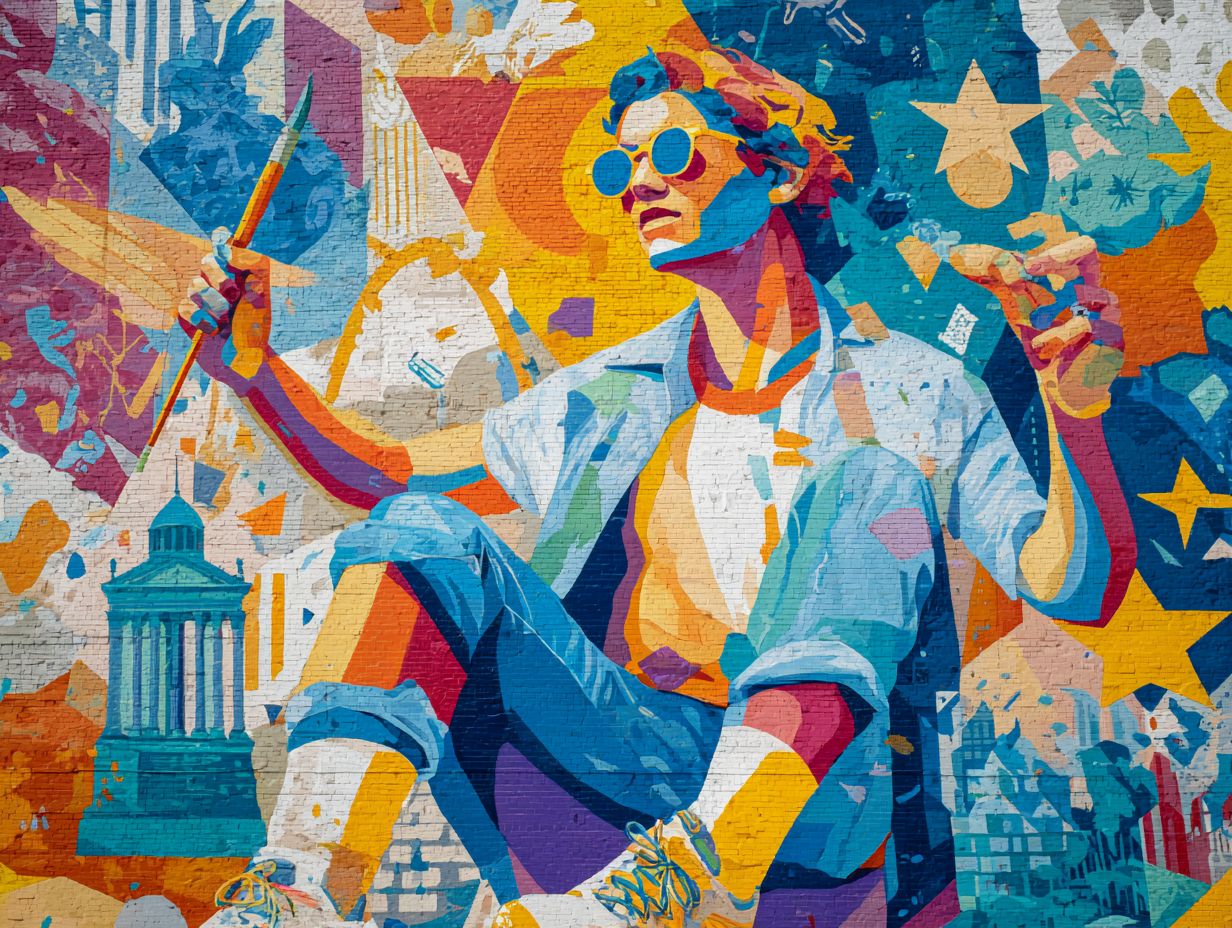
I really believe that fostering open dialogue about controversial art can help us understand and appreciate the diverse perspectives in our communities, enhancing artistic dialogue. One way I like to facilitate this conversation is by organizing community forums where artists and audience members can interact directly, fostering cultural sensitivity.
I often use platforms like Zoom or find local art spaces to host these discussions, promoting art exhibitions. I think it’s a great idea to invite guest speakers, like art critics or social activists, to provide some context and spark deeper conversations.
I also love implementing workshops that encourage participants to create art inspired by our discussions, which really fosters creativity and personal expression. Tools like Miro are fantastic for collaborative brainstorming, and I find that social media can really amplify these conversations beyond the venue, engaging a wider audience in the mix and exploring performance art.
Frequently Asked Questions
What is free speech and artistic expression, and how do they relate to creative rights?
Free speech and artistic expression are fundamental human rights that allow individuals to express their thoughts, opinions, and ideas without fear of censorship or punishment, safeguarding civil liberties. It encompasses a wide range of forms, including visual art, music, writing, performance, and more.
How can art push legal boundaries and explore the parameters of art?
Art can push legal boundaries by challenging social norms and addressing controversial topics such as politics, religion, and sexuality, often leading to legal challenges. Sometimes, this can result in legal action being taken against the artist or artwork if it is deemed offensive or harmful.
What are the legal limitations on free speech and artistic expression, and how do they relate to obscenity laws?
The legal limitations on free speech and artistic expression vary depending on the country and its laws. In general, there are restrictions on speech that incites violence, hate speech, and obscenity. Additionally, the government can also impose limits on speech that is considered a national security or public safety threat under legislative measures.
Can an artist be held legally responsible for their artwork?
Yes, an artist can be held legally responsible for their artwork if it violates any laws or infringes on the rights of others, such as defamation. For example, if an artwork contains copyrighted material without permission or defames someone, the artist may face legal consequences.
How can an artist protect their right to free speech and artistic expression?
An artist can protect their right to free speech and artistic expression by understanding the laws and regulations that govern their country and making sure their artwork does not violate them. It is also important to have a strong understanding of intellectual property rights and obtain necessary permissions or licenses when using others’ work in their own, respecting private property.
Is it possible for art to inspire change through pushing legal boundaries?
Yes, art that pushes legal boundaries can inspire change by challenging societal norms and sparking important conversations. It can also bring attention to important issues and promote social and political activism. However, artists should also be aware of the potential consequences and consider the impact their artwork may have on others.
Want to keep exploring the fight for free expression and digital rights? Visit the BertrandPancher.com home page for more in-depth articles, fresh perspectives, and resources on protecting free speech in the modern world.